
Out of Bounds, Out of Report: The Non–Operated Problem And How To Fix It
Non-operated assets account for around half of oil and gas production for many leading companies, yet flaring and emissions from these assets are often significantly underreported due to poor data access and weak governance. Our analysis shows that more than half of flaring from non-operated assets is missing from standard disclosures, despite most of it being routine and avoidable, creating growing regulatory, investor and reputational risks.
Poor visibility also means companies are overlooking commercially viable opportunities to capture gas, increase revenues, strengthen energy security and reduce emissions. Independent monitoring through Capterio’s FlareIntel platform demonstrates that these gaps are governance choices, not technical constraints, by enabling comprehensive flare tracking across all assets regardless of operator.
EXECUTIVE SUMMARY
- So-called “non-operated assets” account for roughly half of oil and gas production for many leading companies, yet remain a major blind spot in emissions oversight. Limited data access, inconsistent reporting and challenged governance mean flaring and associated emissions are often systematically underreported.
- Our analysis of the top 20 fields in which leading oil and gas companies hold equity shows that more than half of flaring from non-operated assets is missing from standard voluntary disclosures, despite around 90% of this flaring being routine. As scrutiny from regulators, investors and industry intensifies, traditional distinctions between operated and non-operated assets are becoming increasingly difficult to justify. New rules, including the EU Methane Regulation, will add further pressure.
- The issue is set to grow. Companies are re-entering “major resource-holding countries”, where non-operated partnerships dominate and flaring intensities are higher. At the same time, assets are increasingly being consolidated into separately reported entities, reducing disclosure without reducing real-world emissions.
- The implications go far beyond compliance and reputation: poor visibility of flaring can mean material commercial opportunities are being missed. When flaring is underestimated, the economics of mitigation projects are underestimated too. Viable investments that could increase revenues, improve energy security and reduce emissions are simply never identified, developed, or pursued.
- There is another way. Independent data from Capterio’s FlareIntel platform enables emissions monitoring across all assets, regardless of operator. FlareIntel tracks, measures and categorises every flare (for every asset, company and country) every day. This unique and independent operational diagnostic gives companies better visibility of flaring while improving operational oversight, reducing equipment failures and optimising performance. Rich data also helps identify and prioritise investment opportunities to capture flared gas, strengthen energy security, increase revenues, create commercial value – and reduce emissions.
Data gaps in non-operated flaring are governance choices, not technical constraints. What was once invisible is now visible. Let’s unlock the opportunities it reveals.

Introduction
The oil and gas industry runs on partnerships. Scale, cost and risk mean companies rarely act alone. Whether drilling a $100 million exploration well or delivering a billion-dollar development, companies routinely share ownership, risk and expertise. These partnerships transfer knowledge, enable development and support the licence to operate.
Yet there is almost always a clear hierarchy. One partner acts as operator, responsible for day-to-day decisions, while the others hold so-called “non-operated” equity positions. The term “non-operated” is generally synonymous with “operated by others” (OBO), “non-operated JV” (NOJV), “partner-operated”, etc.
These assets are far from marginal. For many companies, they account for roughly half of total production and a similarly large share of emissions exposure. Figure 1 provides a global overview of supermajor production, split by operated and non-operated assets and by region, based on a 2022 Environmental Defense Fund report[1]. EDF’s “Emission Omission” report[2] also highlighted the reporting challenge associated with non-operated emissions. A 2024 Clean Air Task Force “Flaring Accountability” report[3] reached similar conclusions, while showing that some non-operated assets can perform better than operated ones, with lower flaring intensities.
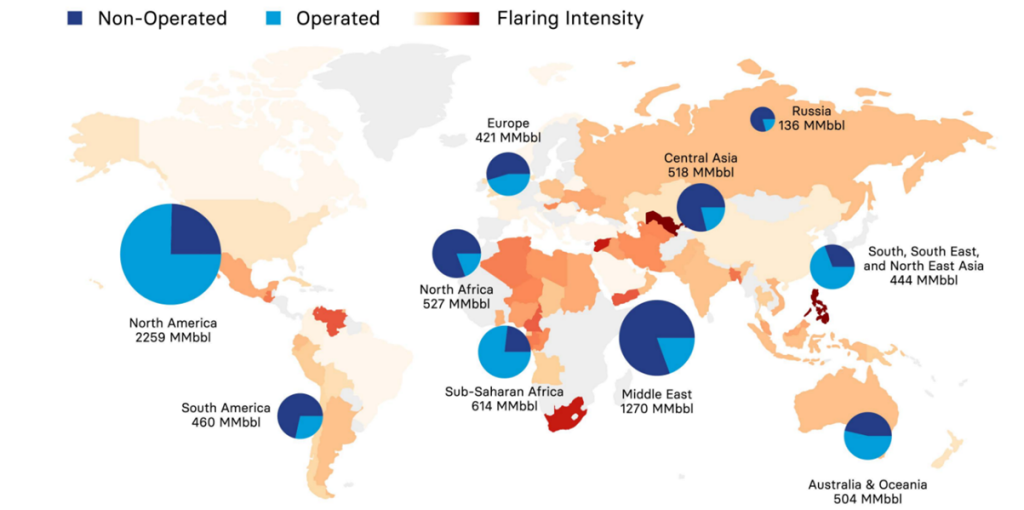
Figure 1: Overview of IOC equity production by operated / non-operated status, colour-coded by flaring intensity. In many regions, the IOC’s production is dominated by its non-operated assets (especially, for example, in the Middle East, North Africa or Central Asia). Figure reproduced from the EDF report “Joint action: Catalysing methane emission reduction at oil and gas joint ventures” from 2022.
The blind spot
Oversight of emissions in non-operated assets is often weak. As we show below, the assumption that “there is always an operator, and therefore emissions are always reported” does not hold. Non-operated partners frequently depend on delayed, incomplete, or inconsistent disclosures – and in some cases, emissions are not reported at all.
Without visibility, companies cannot challenge performance, manage risk, or capture commercial opportunities. North Africa illustrates the scale of what is being lost. The region could supply up to 21 BCM per year of currently wasted gas to Europe using export infrastructure that is only 34% utilised (see our article, “Europe’s Untapped Gas Opportunity: North Africa’s $6 Billion Flares”). Given that North Africa already exports 41 BCM annually through four pipelines and four LNG terminals, recovering even a portion of this additional 21 BCM would represent a material increase in supply.
Crucially, this gas carries little exploration risk because it is already being produced and flared. Recovering it, therefore, offers a strategic alternative to additional Russian, Qatari, or US gas imports. In today’s volatile geopolitical environment, diversifying Europe’s gas supply in this way represents a rare win-win opportunity: it increases revenues for exporting countries while also helping them align with forthcoming EU Methane Regulations.
To quantify the gap, Capterio examined 2024 data for the top 20 flaring assets globally in which at least one Oil and Gas Climate Initiative company (OGCI)[4] held an equity stake. According to the World Bank, these fields flared 12.5 BCM of gas in 2024, equivalent to around $2 billion in lost revenue. We then assessed how much of this volume should have been reported by the operator, either through the World Bank’s Zero Routine Flaring (ZRF[5])by 2030 initiative, OGCI disclosures or the Oil and Gas Decarbonisation Charter (OGDC[6]).
The data
The results are stark. At best, less than half of the flared volume appears to be reported and, under some frameworks, coverage falls below one-third (Figure 2). Specifically, because only 12 of the 20 operators of the Top 20 fields participate in either the World Bank’s Zero Routine Flaring initiative or the OGCI/OGDC frameworks, our analysis indicates that only around 5.8 BCM, or 46% of the total 12.5 BCM flared in 2024, can reasonably be expected to be reported. In other words, more than half of the flared volume associated with the OGCI’s Top 20 assets is not captured by any reporting framework.
Coverage is lower still when assessed against individual initiatives: 44% of volume is reported to the World Bank framework, 39% to OGCI/OGDC, and only 29% to OGMP. These gaps are not the result of immaterial emissions, nor do they depend on the underlying flaring intensity of the assets. Rather, they arise because, in many cases, the operator, often a joint venture or national oil company, either has no formal reporting obligation or does not consider itself bound by one. While this analysis uses a limited dataset, the pattern is consistent with our wider experience.
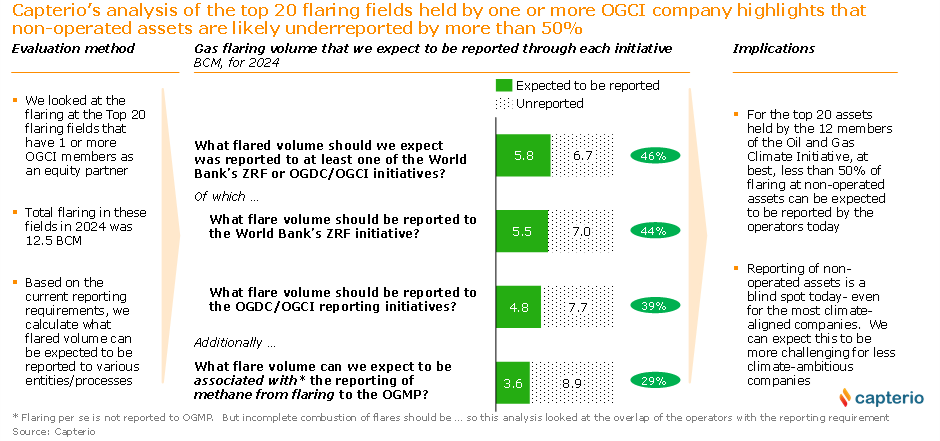
Figure 2: Summary of analysis of the reporting of flaring to various bodies based on the portfolios of OGCI member companies for flares in 2024. We find that less than half of the flared volume is expected to be reported (i.e., the majority of the flared volume is operated by a company with no such reporting obligations). Consequently, investors and companies are being exposed to undisclosed risks.
The data above show that the assumption that “the operator will report” does not hold. A substantial share of global flaring occurs outside any meaningful disclosure framework, creating a significant blind spot in both corporate reporting and collective climate commitments. As international players increasingly (re-)enter legacy assets, access to independent, real-world data will become critical for accurately baselining performance, assessing liabilities, and understanding the true scale of operational emissions.
But flare characteristics matter too. FlareIntel, which tracks and categorises every flare globally using daily satellite observations, provides rich operational insight. FlareIntel’s algorithm automatically categorises every flare on a daily basis as either “routine” or “non-routine” in nature[7]. We find that “routine” flaring accounts for 90% of flaring at these Top 20 fields.
By way of example, Figure 3 shows daily flaring profiles from two of these Top 20 flaring fields, using data from Capterio’s FlareIntel platform. Both fields are operated by entities with no obligation to report flaring data to global initiatives (e.g. the World Bank Global Gas Flaring Reduction Partnership, OGCI, OGDC, or OGMP 2.0) – hence, none of this volume is reported.
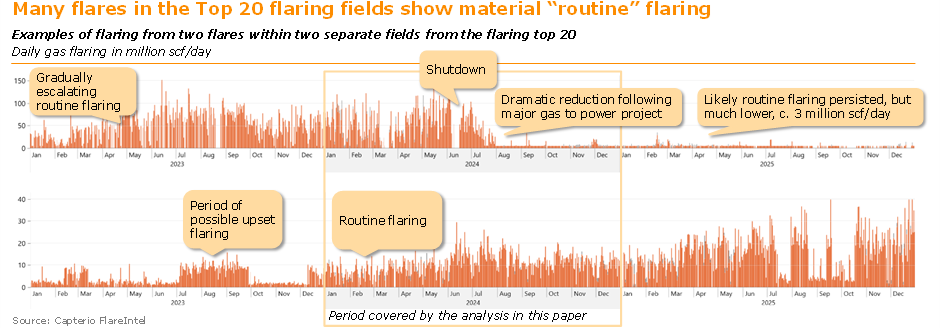
Figure 3: Examples of daily flaring from flares from the Top 20 fields in this analysis. These are clearly “routine” flares, being continuous (i.e. almost every day) and stable (albeit with some variation). Since neither operator is signed up to any reporting initiative, these volumes are not reported.
Flaring at the field shown in the top profile was predominantly “routine” in nature, regularly reaching volumes of up to 100 million scf/day. Following a shutdown and reconfiguration project, we confirmed that most of this gas was captured for use in a power generation project. This provides a clear demonstration of the substantial emissions reductions that can be achieved through flare capture initiatives (even though flaring persisted at a much lower level – and is most likely “routine” in nature[8]). We profile many other examples of flare capture projects (over a range of scales, technologies and countries) in our 2025 paper “Igniting Action to Reduce Gas Flaring: Real Opportunities, Real Projects, Real Results” published with Columbia University. Flaring at the field in the bottom profile was also “routine” in nature, but increased progressively over the reporting year (with multiple issues thereafter), most likely as a direct result of increasing underlying oil production.
These profiles showing “routine” flaring are representative of many fields. And since OGCI member companies (and others) have committed not only to eliminating routine flaring in operated assets but also to “leveraging our influence to achieve the same in our non-operated portfolio”[9], there is a clear opportunity to step up. A coordinated effort to address routine flaring could improve energy security, increase revenues and reduce emissions. For North Africa, these additional supplies could bring a much-needed advantage.
We also see an unacceptable gap between what should and what is reported. 85%+ of the 44 ODGC members that are not OGCI members did not report flaring in 2025[10] (and in only in 2021 did all 12 OGCI companies report flaring). Similarly, 40% of the companies endorsing the World Bank’s Zero Routine Flaring initiative did not do so in 2024[11]. Yet these data are available in our Capterio FlareIntel platform. If they are available to us through our proprietary platform, they are also (or could be) available to all reportees.
Why it matters
Non-operated assets create a structural blind spot. A significant share of emissions sits outside effective disclosure despite clear economic ownership and financial exposure. As regulatory pressure rises, including the EU Methane Regulation, this gap may become harder to sustain.
This problem persists despite more than 60 companies being affiliated with at least one of the OGDC, OGCI and the World Bank’s ZRF initiatives. It creates six main challenges – and arguably most importantly – meaning that attractive investment opportunities are being missed.
- First, oversight is limited. Non–operated assets are typically monitored through periodic reviews, constrained by legal contractual limits on data sharing, internal processes, and fragmented information flows. (And sometimes the legal barriers and/or organisational structures can discourage proactive engagement.) Many partners rely on delayed datasets (quarterly or annual), while others have none. Without timely, reliable data, even well–intentioned partners struggle to challenge performance or support mitigation. Some appear quite comfortable not knowing their non-operated flaring.
- Second, reporting is inconsistent – and sometimes absent. The quality of reporting varies widely. Some assets are managed by operators with robust measurement systems and high disclosure standards. Others are operated by entities with less stringent ambitions. Consider the El Sharara field, Libya’s largest oilfield, formally operated by Akakus Oil Operations[12] with partners including Repsol, OMV, Equinor, TotalEnergies, and the National Oil Corporation. While the partners are all signatories to major international initiatives, the operator itself is not – meaning emissions from this asset are not systematically reported.
- Third, evolving corporate structures are blurring reporting boundaries. Across countries including Angola, Egypt, Iraq and the United Kingdom, supermajor assets are increasingly being consolidated into newly formed joint entities. Emissions that were once reported by individual operators therefore move into vehicles or business combinations with lower or different disclosure standards (or no disclosure at all). Azule Energy, the joint venture between bp and Eni in Angola, is a good example[13]. Assets previously reported through OGCI or in World Bank ZRF initiatives by the parent companies are no longer disclosed through those frameworks, either by the companies themselves or by Azule. That said, Azule is firmly committed to voluntary emissions reduction initiatives, not least through its membership of OGDC and OGMP. It is also instrumental in the ongoing progress of Angola’s flagship LNG project (see our case study as part of our 2026 report “Igniting Action to Reduce Gas Flaring: Real Opportunities, Real Projects, Real Results”).
Nevertheless, the net effect is that emissions can effectively disappear from parent-company reporting without any reduction in real-world emissions. The same issue also arises when assets are divested to non-reporting companies. For example, Shell’s divestment of Nigerian assets to Renaissance reduced OGCI’s reported flaring, even though flaring under the new operator subsequently increased.
The effect is that emissions can effectively disappear from parent-company reporting without any reduction in real-world emissions. The same issue also arises when assets are divested to non-reporting companies. For example, Shell’s divestment of Nigerian assets to Renaissance reduced OGCI’s reported flaring, even though flaring under the new operator subsequently increased. - Fourth, emissions are sometimes excluded entirely due to reporting boundaries. Where companies lack legal title to the gas, some explicitly omit flaring emissions from non–operated assets in their disclosures, citing accounting rules or contractual arrangements. As one company notes: “[our] declared flaring figure does not include emissions from the [X] field, in accordance with international accounting rules … Responsibility for flaring is assigned to the National Oil Company”.
Ambiguity also arises in the scope of climate commitments. For example, when a National Oil Company commits to reporting flaring from its operated assets, it is often unclear whether this extends to its wholly-owned subsidiaries or affiliated operators. In some cases, operator status itself is contested: companies may publicly present themselves as operators while simultaneously disclaiming that role in formal reporting. Further confusion stems from inconsistent use of terminology, particularly between “operator” and “under operational control”, which are often interpreted differently across reporting frameworks. - Fifth, reported emissions are sometimes unreliable estimates. In many NOC–led jurisdictions, flaring is not directly metered. Reported figures are typically based on proxies – such as mass balance calculations, based on valve openings or gas–oil ratios – with limited independent verification. The result is significant uncertainty and, in some cases, an underestimation of emissions exposure.
- Sixth, some of the most attractive emissions-reduction opportunities are being missed simply because they remain invisible. Poor flare metering – combined with years of limited attention – often leads to major underreporting. And when flaring is underestimated, so too is the value of capture projects, leaving commercially viable investments unpursued. In one case, flaring at an NOC-operated asset was found to have been underestimated by up to 8 times until data from FlareIntel (later corroborated by further work) were used. It is little surprise that no action had been taken when, for years, neither the scale of the emissions nor the commercial opportunity had been properly understood.
The shift toward non-operated assets is likely to accelerate. Companies are showing renewed interest in brownfield developments in resource-rich countries such as Iraq, Libya and Algeria, where non-operated positions are common and flaring intensity is often higher. At the same time, many are increasingly using separately reported incorporated entities to manage risk and capture synergies. The result: a growing disconnect between control and ownership.
How to fix the reporting gap (and hence drive faster action)
For non-operated partners, influence without visibility is weak. Joint operating agreements and shared ambitions may exist on paper, but action requires consensus. Operators decide what happens on the ground, subject to agreements with the Operating Committee. Without timely data, non-operated partners cannot ask the right questions or provide meaningful challenge (see our article “Reframing Responsibility: A Systems Approach To Ending Gas Flaring”).
Expectations are shifting. Initiatives such as the Oil and Gas Methane Partnership (OGMP[15]) are moving towards requiring the inclusion of non–operated assets in reporting over time (although only for methane, not flaring), starting in 2027 for leading companies. At the same time, investors are scrutinising the gap between reported profits and incomplete emissions disclosures. The concept of “operations under our control” is narrowing, particularly where companies retain significant influence despite not being the formal operator.
The information gap is no longer unavoidable. Independent asset-level data, such as daily flaring observations from FlareIntel, gives consistent visibility across assets worldwide. Non-operated partners no longer have to rely solely on operator-reported data. They can spot issues, question performance, and work with operators to improve outcomes. This supports collaboration rather than creating conflict. We have seen this in practice. One client discovered that its operating partner was switching from flaring to venting during senior management site visits to create the appearance of zero flaring. Real-time FlareIntel data gave the non-operated partner the evidence needed to challenge this practice and support corrective action, leading to an immediate response and lasting behavioural change.
Alongside better data, reporting frameworks must evolve. The traditional model – reporting operated flaring on a 100% basis – reflects operational accountability, but creates inconsistencies for some non-operated assets. We propose four fixes:
- Firstly, the industry could move beyond reporting only operated flaring to also include equity-based reporting across all assets (as some companies are already doing). This would provide a more complete and credible picture of a company’s emissions footprint, aligning responsibility with economic interest. Reporting should include flaring even where there is no title to the gas (since flaring is intrinsically linked to underlying oil production), and should capture volumes associated with technical service contracts.
- Secondly, Oil and Gas Methane Partnership 2.0 could expand its scope to include emissions associated with flaring (i.e. the overwhelming majority of volume), rather than just methane from flaring (from incomplete combustion and/or unlit flares). This will become especially important as members begin reporting non-operated assets (typically in year five of membership, i.e. 2027 for some leading companies). This may become important if OGMP seeks to align closely with, or become a standard for, upcoming EU Methane Regulations.
- Thirdly, non-operated partners could do more than “use their leverage to influence” partners. Instead, they could actively use their governance rights and commercial leverage to require operators to meet equivalent reporting standards. This includes embedding reporting requirements in joint venture agreements, exercising voting rights, and linking capital allocation to transparency performance.
- Fourthly, to improve data integrity, all flaring reporting should be subject to independent third-party review. To date, validation is largely “paper-based” (if conducted at all), and focused on processes, not data. A shift to “content-based” assurance, grounded in independent quantitative evidence such as FlareIntel, would represent a major improvement. As argued in “The Investor Advantage: Using Better Data”, current audits often fail to identify gaps in asset inventories, inaccurate disclosures, unrealistic assumptions, or inconsistent classifications (such as of “routine flaring”) or calculations (e.g. some “flaring intensities” use oil as a denominator, others include gas). QC issues may also explain why flaring figures are repeatedly revised across successive annual reports. We need to learn from President Reagan’s maxim: “Dovorey no provorey” (“trust, but verify”).
As data becomes more accessible and expectations continue to rise, the distinction between operated and non–operated assets will matter less. What will matter is transparency, accountability, and the willingness to act. Closing the non–operated emissions gap will require companies to move beyond passive influence – to actively engage, challenge, and collaborate across their full portfolio. The tools to do so now exist. We need wait no longer.
[1] https://business.edf.org/insights/joint–action–catalyzing–methane–emission–reduction–at–oil–and–gas–joint–ventures/, co–authored by Capterio
[2] https://www.edf.org/sites/default/files/documents/Emission%20Omission_%20A%20Shareholder%20Engagement%20Guide.pdf
[3] https://www.catf.us/2024/11/new-catf-report-shows-flaring-emissions/
[4] a consortium of 12 major oil and gas companies with some of the boldest commitments and arguably some of the better climate performance. https://www.ogci.com/who–we–are/
[5] https://www.worldbank.org/en/programs/zero–routine–flaring–by–2030/endorsers
[6] https://www.ogdc.org/signatories/
[7] We note that the World Bank (and others) have a definition of “routine” flaring. However its interpretation is subjective, so we think an independent and data-based definition is preferable – and use quotation marks to recognise any potential difference.
[8] Since the flare is visible on almost every day, and is at a rate that is much larger than could be expected for 1 or more pilot flares.
[9] https://www.ogdc.org/oil-gas-decarbonization-charter/
[10] Of the 55 signatories to OGDC, 17 reported flaring numbers (71%). But of the 17, either 10 or 11 reportees are likely to be from the 11 OGDC members which are also OGCI members. Hence 6 or 7 out of 44 or 45 OGDC members who are not OGCI members reported, i.e. non-reporting was 85-86%. https://www.ogdc.org/wp-content/uploads/2026/02/OGDC-2025-Status-Report.pdf
[11] https://www.worldbank.org/en/programs/zero–routine–flaring–by–2030/reporting
[12] Although Repsol, the lead partner uses the terminology “we operate El Sharara, Libya’s through a joint venture between the Libyan National Oil Corporation and an international group of companies”.
[13] Other examples include Shell and Equinor creating Adura in the UK, TotalEnergies, Repsol and HitecVision creating NEO NEXT Energy in the UK, or bp and ADNOC creating Arcius in Egypt.
[14] Although, as a member of OGDC, however, Azule is expected to report through that framework.
[15] https://www.ogmpartnership.org/sites/default/files/documents/2026–03/List_of_OGMP2.0_Member_Companies_25.03.pdf